Video Summary
9 Key Points Listed.
Followed by Illustration of Each.
1. Business Case. Addressing upcoming competitor. Current Profit $50M/month.
2. The Business Challenge. Identify the Options to address the competitor.
3. Match (ASAP) Option, Passive Option and 3 others.
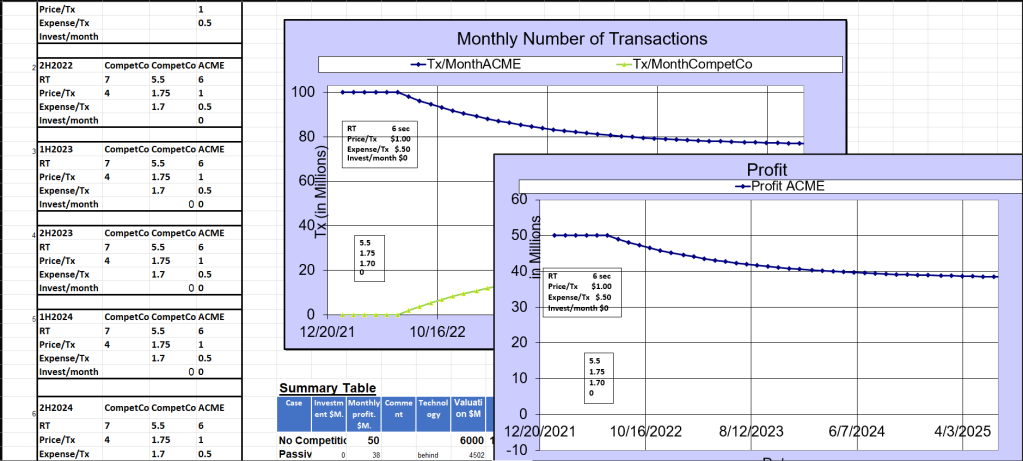
4. Passive Option. Profit $38M/month. Old Technology.
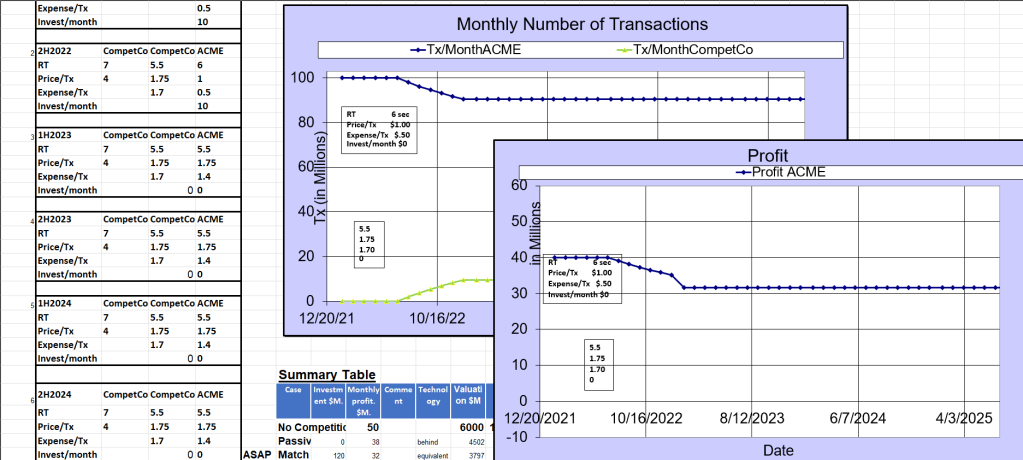
5. Match (ASAP) Option. Profit $31M/month. Equivalent Technology.
6. Mathematical Model driving Graphs. Built on IT, finance and market data.
7. Milking the Cow (Passive) versus Fighting Back (Match) Considerations
8. Options: Block ($50M, risky), When ($28M, Equivalent), Crush ($50M, expensive)
9. Conclusion: 3 Possible Decisions for Management Guidance
1. Business Case. Addressing upcoming competitor.
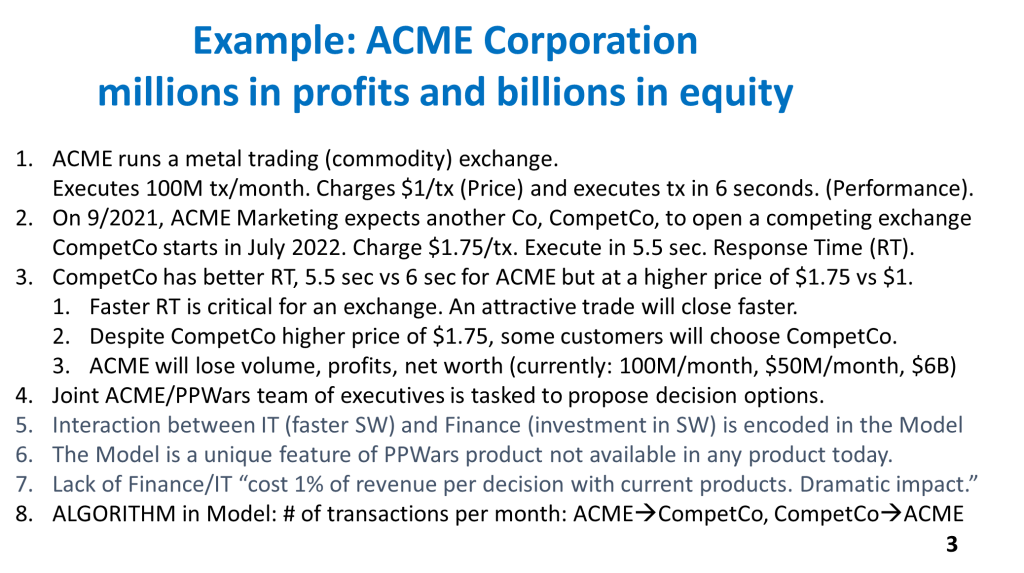
Let’s dive into what exactly does PPWars do? The answer to this is: deliver higher profits and higher company Net Worth. Imagine you are a CFO of ACME Corporation. ACME was early into online metal trading and is the dominant company. Profits are very good for a few years now. No need to invest much in technology. Then business intelligence bring news of an impending competitor. ACME can be kicked out of the market or lose much of its profits and equity, after years of calm. The management team need to decide and act. Fate of ACME and their comfortable career is on the line. Let us see what are the dollar numbers at stake. In Metal Trading commodity Exchange ACME executes 100 million transactions per month. It charges $1 per transaction, which is price and it executes the transaction in 6 second, which is performance. Note the name, PPWars, comes from Price Performance Wars. In September 2021 ACME marketing expects another company, CompetCo to enter the market in July of 2022. CompetCo charges $1.75 per transaction and executes it in 5.5 seconds (response time). CompetCo has better response time 5.5 seconds versus 6 seconds for ACME but at a higher price of $1.75 versus $1. Faster response time is critical for an exchange. An attractive trade will close faster. Despite CompetCo higher price of $1.75 some customers will choose CompetCo. Consequently ACME will lose volume, profit and net worth. Currently the volume is 100 million transactions per month and the profit is $50 million per month. The equity is six billion dollars.
2. The Business Challenge. Identify the Options to address the challenge.
Competition will reduce ACME financial results unless something is done. Doing something (developing faster software) costs money. Faster software will bring more revenue on one hand but requires investment on the other hand. ACME IT came up with a list of development line items that will improve response time. Given the functionality and expense of improved software line item, PPWars will establish the change in profit, revenue and market share to be expected. This is the unique feature of PPWars not available in any product today. Today a line item is picked up for implementation based on gut feeling, experience, etc. PPWars eliminates the resultant rework, experimentation and waiste. With PPWars the line item is picked for implementation based on concrete financial data. Gartner opinion is: “It cost 1% of revenue per decision with current products. Dramatic impact”.
3. Match (ASAP) Option, Passive Option and 3 others.
ACME decided to purchase PPWars software and retained the services of PPWars company to team with its executives to develop decision options. One line item that interested ACME was the financial consequence of matching expected CompetCo offering, the Match option. This Match CompetCo option requires expense of software development (will cost money). Being investment averse, ACME want to see the consequences of Passive option, doing nothing. So those were the first 2 options investigated. The joint team starts its work with Commodity Trading Model available out of the box. This Model is customized to ACME market situation to produce the ACME Model. Using ACME Model the team produces the resultant market share and profit for these 2 options. After evaluating these 2 options, ACME management wanted to see a few more options. Some of those were requested to find the best financial outcome. Other ACME requests for options dealt with possible change in existing ACME corporate strategy.
4. Passive Option. Profit $38M/month. Old Technology.
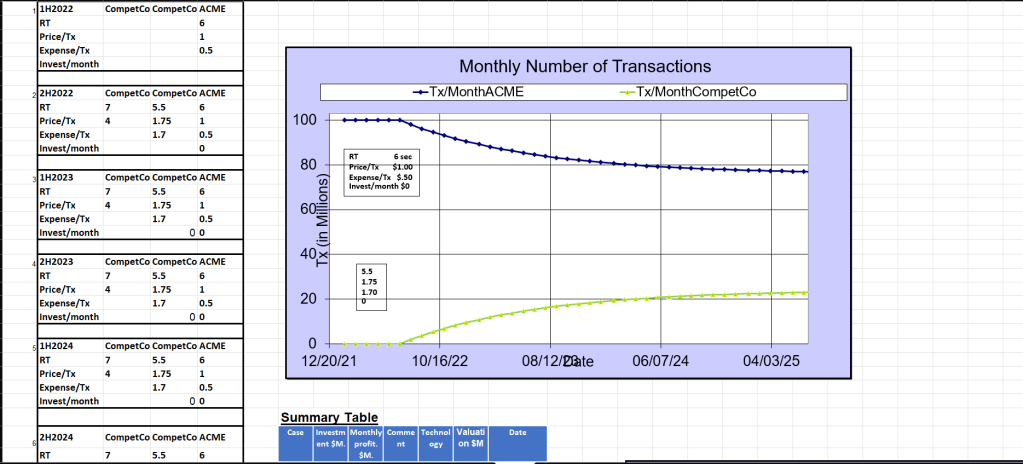
Let us demonstrate this process for ACME versus CompetCo case. This graph shows market share of two companies, ACME and CompetCo over a period of 2022 through 2025. The graph is drawn by PPWars software to forecast market share of metal trading exchange. It shows that ACME had 100% of the market until July of 2022, at which point a different company, CompeteCo enters the marketplace. PPWars software uses the table on the left as input and the graphs on the right as output. ACME has a transaction response time of six seconds and the price of dollar. When CompetCo comes into the marketplace it has response time of 5.5 seconds and $1.75 price per transaction. These graphs forecast market place changes once CompetCo enters the market. The graphs describe the case where ACME “does nothing to counter the competition”, The Passive Case. ACME share of Market declines from 100 million transactions per month to 76 million. PPWars software draws a graph showing profit of ACME over the period. ACME makes a profit of 50 million per month. This profit declines to 38 million per month. Let us record the results of Passive case in Summary Table. In this location.
5. Match (ASAP) Option. Profit $31M/month. Equivalent Technology.
In addition to this Passive Case, another set of graphs is now drawn by PPWars software for the Match Case. ACME IT suggested a project to upgrade ACME offering to match Response Time and Price of CompetCo. The project will take 12 months at a cost of $10 million per month. Let us update the input table with this information. $10 million per month for first six months and $10 million per month for the next six months and then no more. At the beginning of 2023 ACME response time is going to be 5.5 seconds and the price is going to be $1.75. Consequently, PPWars produces the following market share graph. ACME market share declines from 100 million and then stabilizes at 90 million. The profit goes from 50 million $ per month to stabilize at $31 million per month. Let us record the Match Case results in Summary Table. In this location. Summary Table indicates which case is the better choice. Match case put ACME on the same technology generation as CompeteCo. This is important but it results in profit decline to $31 million. In Passive case ACME would be one technology generation behind.
6. Mathematical Model driving Graphs.
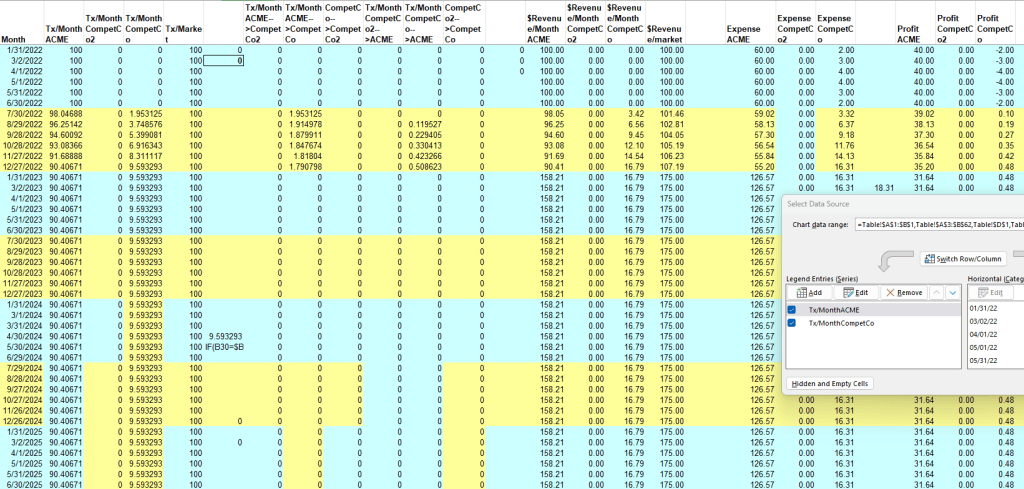
So here we review the table driving these graphs and the mathematical model underlying it. Let us go back to this point in the graph. We see a table with a column of the months. January 2022, June of 2022, May of 2023 number. A column with the number of transactions per month. Initially 100 million for ACME and then go down. Then CompetCo, initially zero for the first six months and then go up. The next 6 columns include the ALGORITHM mentioned earlier. It is based on Sales current and past history. This algorithm tells us how many transactions move from ACME to CompetCo or from CompetCo to ACME in every month. Next, we take the number of transactions in a month and multiply by the price per transaction and get monthly revenue for ACME and the revenue for CompetCo. Similarly, we derive the monthly expenses of ACME and CompetCo. Subtracting expense from revenue we get the profit. This is how the model works. Notice that expense includes investment in IT, too. IT investment improves response time. Response time in turn improves the number of transactions per month. So, the table is a function of Sales, IT and Financial information.
7. Milking the Cow (Passive) versus Fighting Back (Match) Considerations
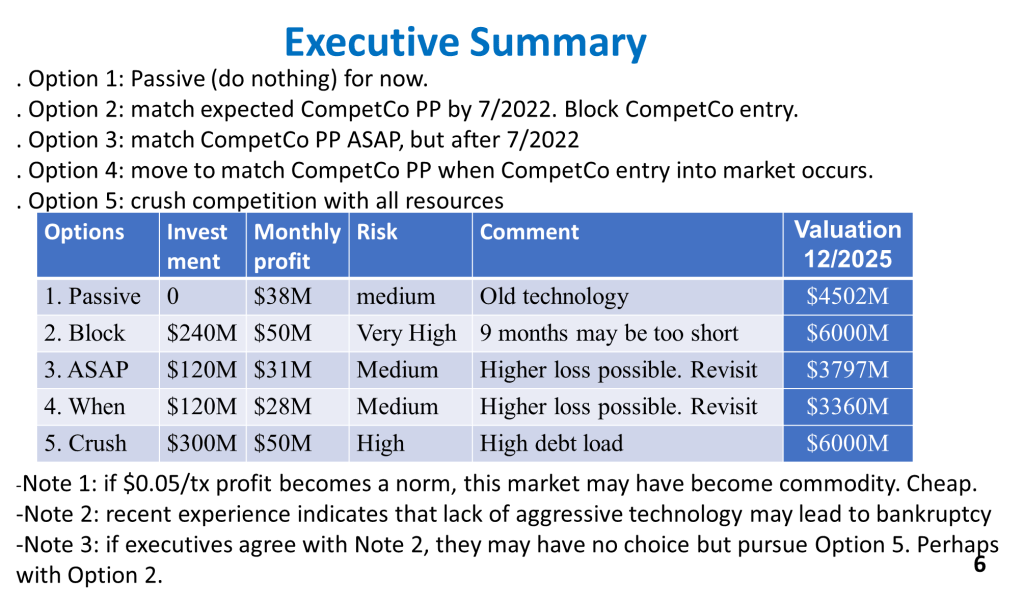
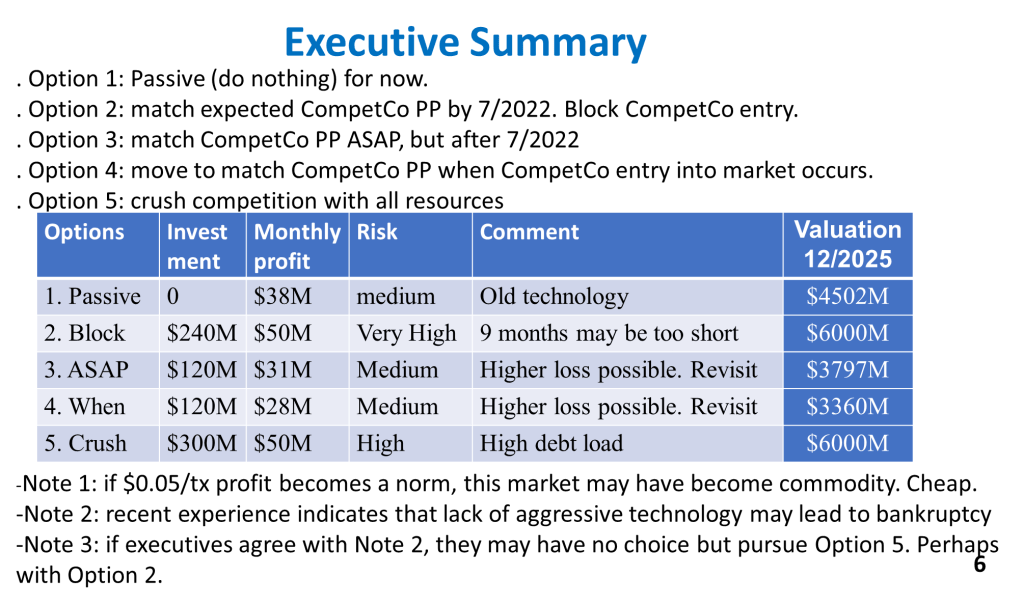
Now that we had a quick look at the model let us summarize what we have in terms of results. This is the executive summary. We discussed already the first option. The passive option: do nothing for now. This row in the table, Passive is when we invest nothing. We wind up with $38 million per month profit instead of 50 million. However the the big problem is that we are stuck with old technology. Our valuation goes from six billion down to 4 and a half billion. Option number three we also discussed. We invested $10 million per month which is 120 million. We wind up with $31 million per month profit and net worth is $3.8 billion instead of six. Net Worth is lower than Passive Option, however ACME technology is equivalent with CompetCo. It is very important to be equivalent. If ACME remains behind in technology, CompetCo can try to move to the next technology and leave ACME to be 2 technology generations behind. Being behind by two levels of technology in today Marketplace can easily lead to bankruptcy.
8. Options: Block ($50M, risky), When ($28M, Equivalent), Crush ($50M, expensive)
The other option here is Block. This option calls for crash project development between September 21 and July of 22. Build software that matches the performance of CompetCo. CompetCo will have nothing to attract transactions and will not able to get into the market. Thus ACME keeps the $50 million monthly profit and the six billion dollars valuation. Option four is the same as ASAP but the IT project starts later when CompetCo entry into the market actually occurs. ACME does not start development in January but rather in July when CompetCo shows up. Because perhaps CompetCo will not show up. Option number five says: let us change the philosophy and approach of the company to be more like what Google does. Google uses all possible resources to develop all possible technologies to be ahead at all time. This option involves developing three levels of technology. Crush competition with all resources. It is going to cost, but the monthly profit and valuation will be unchanged. Let us note that the profit of ACME is 50 cents per transaction and the profit of CompetCo is 5 cents per transaction. So this Market may have become a commodity, cheap from executive perspective. Then as we said, recent experience indicates that lack of aggressive technology may lead to bankruptcy. If executives agree that they have to do something because of bankruptcy danger, they may have no choice but to pursue option five perhaps with option two. We can discuss this later.
9. Conclusion: 3 Possible Decision for Management Guidance
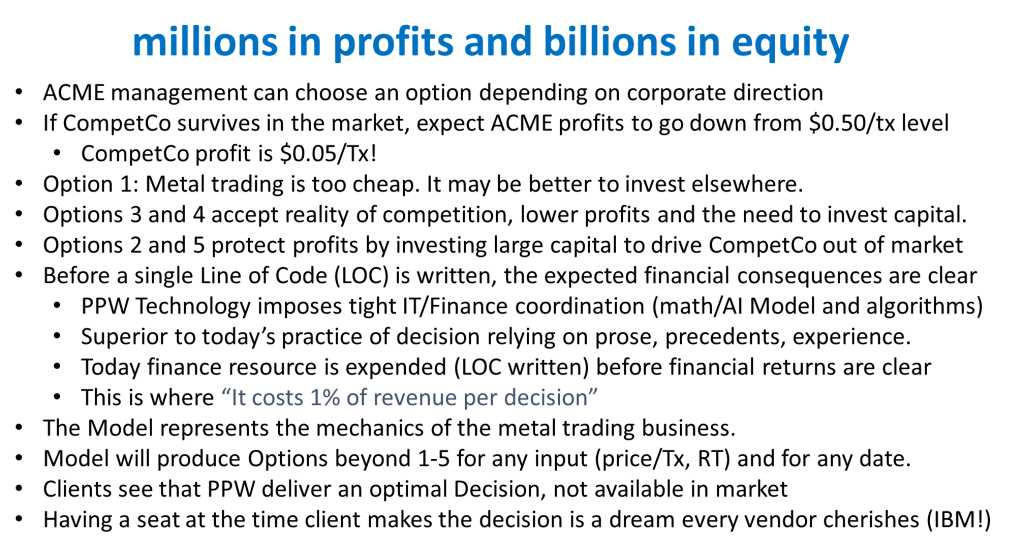
Let us conclude. ACME management can choose an option depending on corporate direction. If CompetCo survives in the market, expect ACME profit to go down from 50 Cent per transaction. Because CompetCo charges just 5 cents per transaction. So, Decision 1 may be: metal trading is too cheap. It may be better to invest elsewhere and make as much money as possible for now. Decision 2 is to pick options three and four, accept reality of competition lower profits and the need to invest capital. Decision 3 is to pursue options two and five. Protect profits by investing large Capital to drive CompetCo out of the market. The important point to notice is that before a single line of code is written the expected financial consequences in PPWars are clear. Because PPWars imposes tight IT versus Finance coordination the results are superior to today’s practice of relying on prose, precedent and experience. Today Financial resources are expended (meaning line of code written) before financial results are clear. That is where it costs 1% of Revenue per decision. The model represents the mechanics of the metal trading business. The model can produce options beyond those 5. Options can be produced for any input price, response time and for any date. It is available at any time. Once clients see that PPWars delivers an optimal decision not available in the market, PPWars will be progressing fast. Clients realize that they can make more money and as a result we can make more money by having a seat at the time the client makes a decision. It is a dream every vendor cherishes (like in IBM for example). Once we have a seat at the table, we can influence the decision for our benefit.